
Every basketball fan has debated which all-time starting five could survive an entire NBA regular season without a single loss. The viral 82-0 game turns that barbershop argument into an addictive, two-minute daily puzzle across web browsers and mobile apps. Rather than letting you hand-pick any legend off the board, it forces you to work with whatever random franchises and historical eras the wheel hands you.
How the 82-0 Game Works
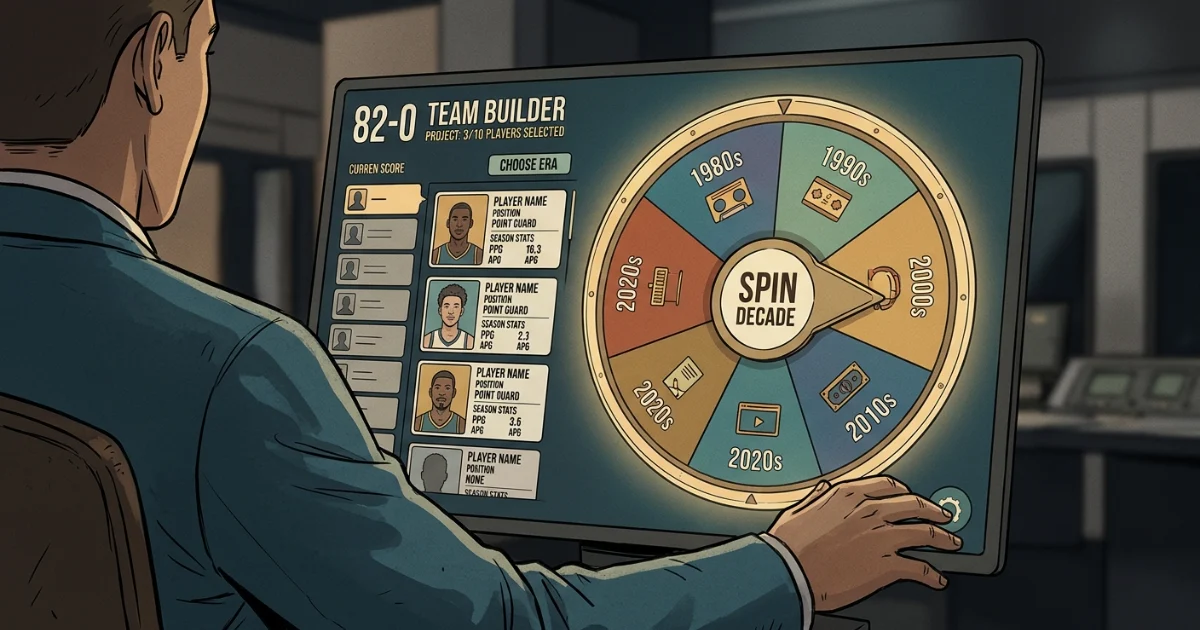
At its core, the 82-0 game is an exercise in rapid-fire basketball recall and statistical triage. Across five rounds—or six rounds in variants like First Down Studio’s version that adds a head coach slot—you spin a slot machine that pairs an NBA franchise with a specific decade. Your job is to type in a qualifying player from that exact team and era to fill one of your five traditional court positions: point guard, shooting guard, small forward, power forward, or center.
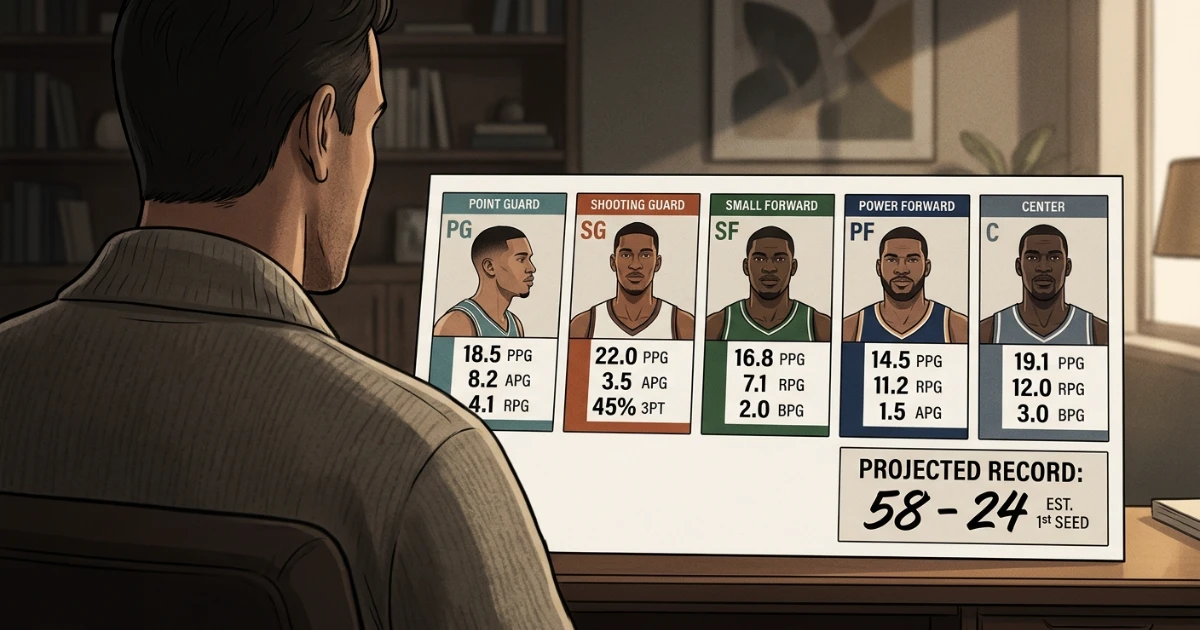
Once your lineup is locked in, the simulation engine calculates a projected regular-season record out of 82 games. While it looks like a pure trivia test on the surface, learning how to win requires understanding what the underlying math actually rewards. The simulation doesn’t care about locker-room chemistry or three-point spacing nearly as much as it cares about raw per-game box score volume—points, rebounds, assists, steals, and blocks—normalized across eras.
How to Go 82-0: Strategy Over Star Power
Landing a 76-6 or 79-3 record happens all the time, but clearing that final hurdle to hit a spotless 82-0 demands disciplined draft management.
First, positional flexibility is king. If you spin the 1990s Chicago Bulls in round one, locking Michael Jordan into shooting guard immediately narrows your future options. Slotting multi-position stars into flexible spots or keeping your center and point guard slots open as long as possible prevents late-round disasters where you draw a franchise with zero eligible players for your remaining position. Most versions of the game give you a limited lifeline—such as a single team respin or decade skip—so saving that panic button for round four or five is essential.
Second, chase statistical outliers rather than household names. Knowing how to go 82-0 in the 82-0 game often comes down to targeting stat-sheet stuffers from high-pace eras. A 1960s Wilt Chamberlain, a 1970s Kareem Abdul-Jabbar, or a triple-double-averaging Russell Westbrook carries massive statistical weight that can offset a weaker pick at another position. Conversely, drafting a legendary late-career veteran—like Michael Jordan on the Washington Wizards—will tank your win total because the engine evaluates the exact franchise-and-era stint you drafted.
Modes, Variants, and Ecosystem Expansion
What started as a simple browser viral hit on platforms like 82-0.com, better-82-0.com, and First Down Studio has rapidly branched out into an entire subgenre of sports roster builders. Depending on where you play, you can toggle between Classic mode—which displays player stat lines to help guide your decision—and blind trivia modes like HoopIQ that hide all numbers, forcing you to rely purely on memory.
The mobile releases from Vaulty Studios on iOS and Android expand the loop with head-to-head PvP duels, private friend challenge links, and daily leaderboards. Meanwhile, the broader ecosystem has adapted the exact same slot-machine drafting formula to nearly every major sport:
-
Football version: Variants like First Down Studio’s Build a 17-0 Team or 20-0 challenge you to draft across offensive and defensive positions using random NFL franchises.
-
Hockey and Soccer: Spin-offs task players with assembling undefeated 82-0 NHL rosters (including goalies) or 38-0 soccer starting XIs across specific tactical formations like a 4-4-2.
-
College and Bench Modes: Community variants and custom modes also experiment with 82-0 game college alumni pools and 82-0 game with bench drafts that add a sixth-man or head-coach modifier to push the difficulty even higher.
Presentation, Pacing, and Mobile Performance
Visually, the 82-0 challenge game embraces clean, functional minimalism. Whether played in a desktop browser or via the dedicated mobile app, rounds load instantaneously with crisp team logos, responsive autocomplete search bars, and easily readable stat breakdowns. Each run takes roughly 90 seconds from the first spin to the final season simulation, giving it the same effortless “one more try” hook as Immaculate Grid or Wordle.
The only noticeable friction appears in the free-to-play mobile versions. While the browser editions are largely uninterrupted, frequent full-screen interstitial ads between drafts on iOS and Android can break the snappy rhythm if you are grinding out dozens of attempts in a single sitting. Furthermore, because the simulation leans heavily on raw box-score formulas rather than advanced defensive metrics or modern lineup synergy, basketball purists may occasionally scratch their heads when an awkward, zero-spacing lineup sweeps the league while a balanced modern superteam finishes 78-4.
Final Thoughts
Even with its quirks in how it weighs historical stats, the 82-0 game nails the sweet spot between quick-hit casual gaming and deep sports nerdery. It turns obscure NBA franchise knowledge into a tense, high-stakes draft puzzle that costs nothing to play and endlessly rewards experimentation. Whether you are chasing your first undefeated banner on your lunch break or trading challenge links with friends, it stands as one of the sharpest sports trivia games available.